
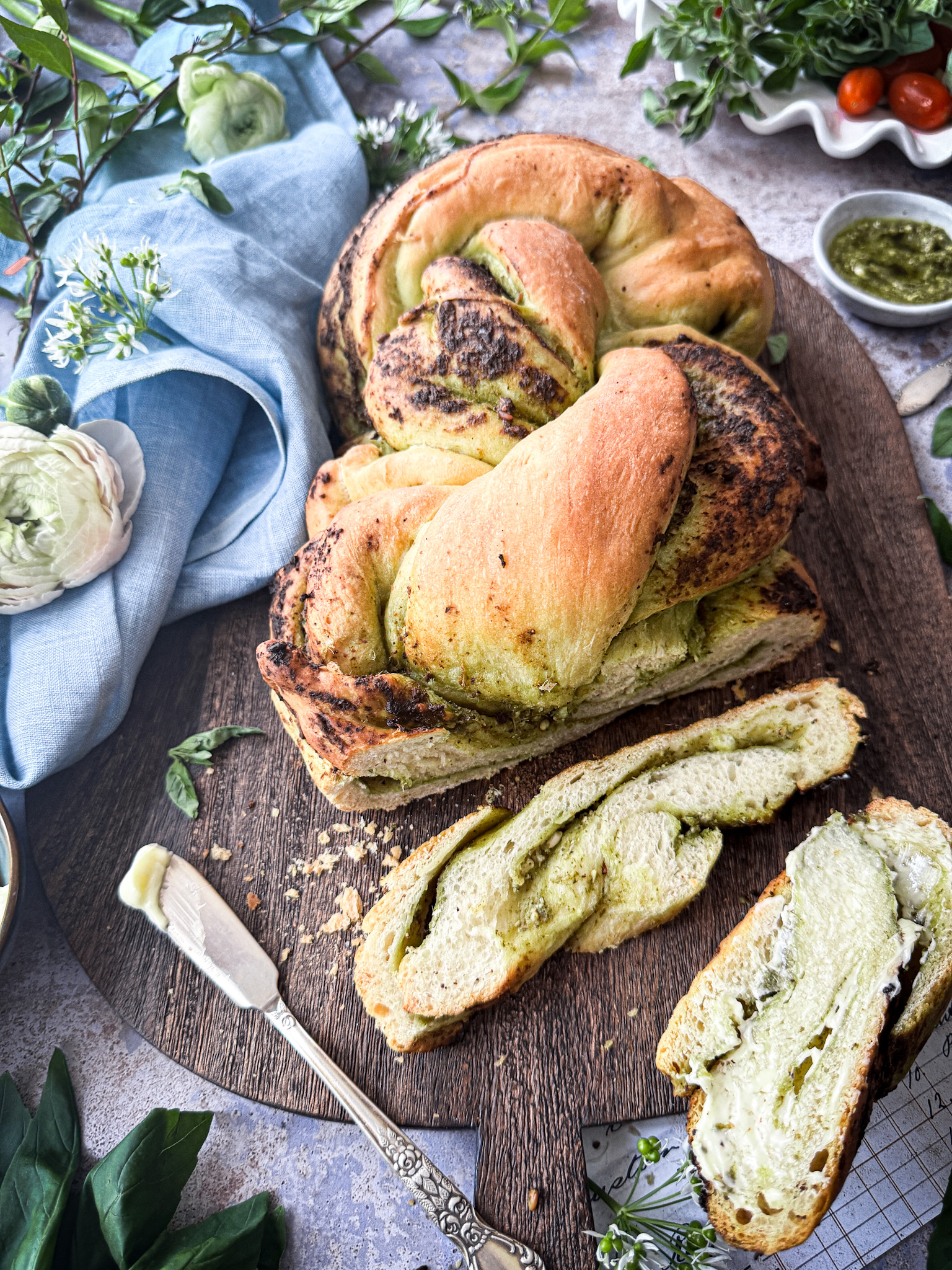
Discover the taste of summer with our best swirled pesto bread recipe —light, doughy, and super soft. This delightful bread combines the goodness of homemade pesto, and adds an extra touch of fancy to your dinner table. And the best part? It’s much easier to make than you might think! Let the stand mixer do all the kneading work, then roll out and spread with our easy homemade pesto. Braiding and swirling this bread is so much easier than you would expect!
Once baked, allow it to cool before slicing. Serve it warm straight from the oven with a little smear of butter, and you’ll be in heaven. Swirled Pesto Bread is everything that is right in the world. It’s cheese, pesto, and bread — the best combination! You’ll love this bread, and it’s a great way to use up all the fresh summer herbs from your garden.
The weather has been perfect lately. I spent most of the long weekend preparing for a photoshoot and planning content for the coming months. My list of summer recipes keeps growing, with ideas perfect for barbecues, garden parties, family dinners, simple gatherings with friends, or even watching the Olympics.
Enter this best swirled pesto bread recipe. It’s so pretty and delicious, making it perfect for all your upcoming summer events. And while this bread may look complicated to make, it’s actually quite simple. The step-by-step photos in this post will be very helpful, so study them closely.
Ready to impress your guests with stunning and tasty bread? Let’s get started with this easy, yet impressive, swirled pesto bread recipe.
Here’s why we love this recipe so much:
- Soft, stretchy dough that easily adapts to your touch!
- It effectively utilises all your summer herbs.
- It shines on its own, but truly excels when toasted and accompanied by butter or pesto.
- Simple to master, even for baking novices like myself.
What’s In Best Swirled Pesto Bread Recipe?
Let me dive into the delightful details of this swirly, pesto bread.
The bread dough itself comprises a simple mix of white bread flour, yeast, whole milk, water, oil, salt, and sugar. While these ingredients may not be groundbreaking, they certainly result in a delicious outcome. Homemade pesto is swirled into the dough.
But the true star of this bread lies within its layers and swirls. It’s all about the homemade pesto, elevated by the abundance of herbs from the summer garden. Every bite infuses those classic flavors we all crave. It’s like capturing the essence of summer in bread form!
This bread isn’t just a delight for the taste buds; it’s also a clever way to make use of the surplus of herbs from the garden.
Ingredients Used to Make The Best Swirled Pesto Bread Recipe:
- Bread flour: This gives the bread its soft, fluffy texture. You can also use plain (all-purpose) flour, but the texture will be slightly different. Avoid using wholemeal flour as it will make the bread too dense.
- Instant yeast: Use instant yeast, which can be added directly to the flour without needing to be activated first.
- Salt: Essential for good bread; don’t skip it.
- Sugar: A small amount feeds the yeast, helping the dough to rise. You can use caster or granulated sugar.
- Olive oil: Adds fat to the dough, keeping it soft and adding flavour. Choose a mild olive oil or any other neutral oil.
- Water and milk: These liquids form the base of the dough. You can use any plant-based milk to keep the recipe vegan.
- Pesto: You’ll need either a jar of pesto or about 150g of homemade pesto. Both options work well.
How to Make The Best Swirled Pesto Bread
Mixing the Dough:
Start by placing the bread flour into a large bowl or the bowl of a stand mixer fitted with a dough hook. Add the yeast on one side of the bowl and the salt and sugar on the other, ensuring the salt doesn’t touch the yeast directly. Pour in the olive oil and about two-thirds of the water. Mix everything together until you get a rough, shaggy dough, gradually adding more water as needed until the dough is sticky but not wet. You might not need all the water, or you may need a bit more.
Kneading:
Transfer the dough to an un-floured surface and knead it for about 10 minutes until it becomes smooth and elastic. If you’re using a stand mixer, let it knead the dough on medium speed for 5-10 minutes. The dough is ready when it passes the windowpane test—it should be smooth, elastic, and slightly tacky but not too sticky.
First Rise:
Place the dough in a lightly oiled bowl and cover it. Leave it to rise in a warm spot for 90 minutes to 2 hours until it doubles in size, or leave it overnight in the fridge.
Rolling and Twisting:
After the dough has risen, punch it down and roll it out on a lightly floured surface into a rectangle measuring about 30 x 45cm. Spread the pesto evenly over the dough, leaving a 2cm border around the edges. Starting from the long edge closest to you, roll the dough up tightly but gently to form a log.


Shaping:
Line a baking sheet with parchment paper or sprinkle it with semolina. Place the rolled dough on the sheet. Use a sharp knife or bench scraper to cut the log in half vertically, revealing the layers of pesto inside. Twist the two pieces of dough together to form a loose twist. Coil one half of the dough rope like a snake until you reach the midpoint. Then, coil the other half in the opposite direction. Cover and let it rise in a warm place for 45 minutes.


Second Rise and Baking:
Allow the shaped bread to rise again until it puffs up. Bake the bread according to the recipe instructions below. Enjoy it warm from the oven, ideally with a smear of butter.
Helpful Tips and Tricks to Make the Best Swirled Pesto Bread
- For the best results, closely follow the recipe. I highly recommend using gram measurements with a digital scale rather than cup conversions. Cup measurements are not precise enough for baking, and I cannot guarantee the best results if you use them. A gram is always accurate, but a cup may vary.
- Avoid adding extra flour to the dough. It should be a bit soft and sticky. Adding too much flour will make the pesto bread dry and dense instead of light and fluffy.
- To check if the dough is kneaded enough, use the windowpane test. Take a small piece of dough and gently stretch it out. If it can stretch thin enough to let light pass through without tearing, it’s ready.
- The rising time of the dough will depend on the temperature. On warm days, it will rise faster than on cold days.
- You can make this pesto bread in one day, or you can prepare the dough in the evening and let it rise overnight in the fridge. If you choose the overnight method, the second rise may take longer because the dough will be cold.
- This swirled pesto bread is best eaten on the day it is baked. However, it will keep in an airtight container for a couple of days.
Afraid you’ll miss a post? Subscribe today and receive updates on new posts, and bonus recipes and information! Follow along on Instagram, Facebook, Tiktok and Pinterest for food inspiration and adventures.
Final Steps: 
Ingredients
method
Mixing the Dough:
Kneading:
First Rise:
Rolling and Twisting:
Shaping:
8 comments
I made this for my book club of eight people, and I only got one slice! It was AMAZING!! There are three bakers in my club, and they all wanted the recipe.
Alaina
Ha, that’s the best kind of problem to have, Alaina! So glad it was a hit with your book club, and especially that the other bakers in the group wanted the recipe, that’s the real compliment. Thank you for making it for the group!
This bread is delicious. I was a little nervous about trying a braided loaf, but it ended up looking beautiful. I used red pepper pesto since that’s what I had. I may have used a little too much because I needed to bake it an extra 10 minutes. I’m anxious to try more of your recipes – so glad I found your site. Thank you for sharing
Heather
Hey Heather,
What a lovely comment. I’m so glad you gave the braided loaf a try and that it turned out beautifully for you. The red pepper pesto sounds delicious, and I’m sure your note about the extra baking time will be helpful for others too. Welcome, and I hope you enjoy exploring more recipes on the site!
This looks amazing, I can’t wait to try it. Can I freeze the dough or leave it in the fridge if I don’t have time to make it that day??
Carmela
Hi Carmela,
I’m glad you like the look of the recipe! Yes, you can definitely freeze the dough. Just wrap it tightly in plastic wrap and place it in a freezer-safe bag. You can also leave it in the fridge for up to 24 hours if you don’t have time to make it the same day.
Thanks Mini
The recipes look stunning.
Thank you Tina.