
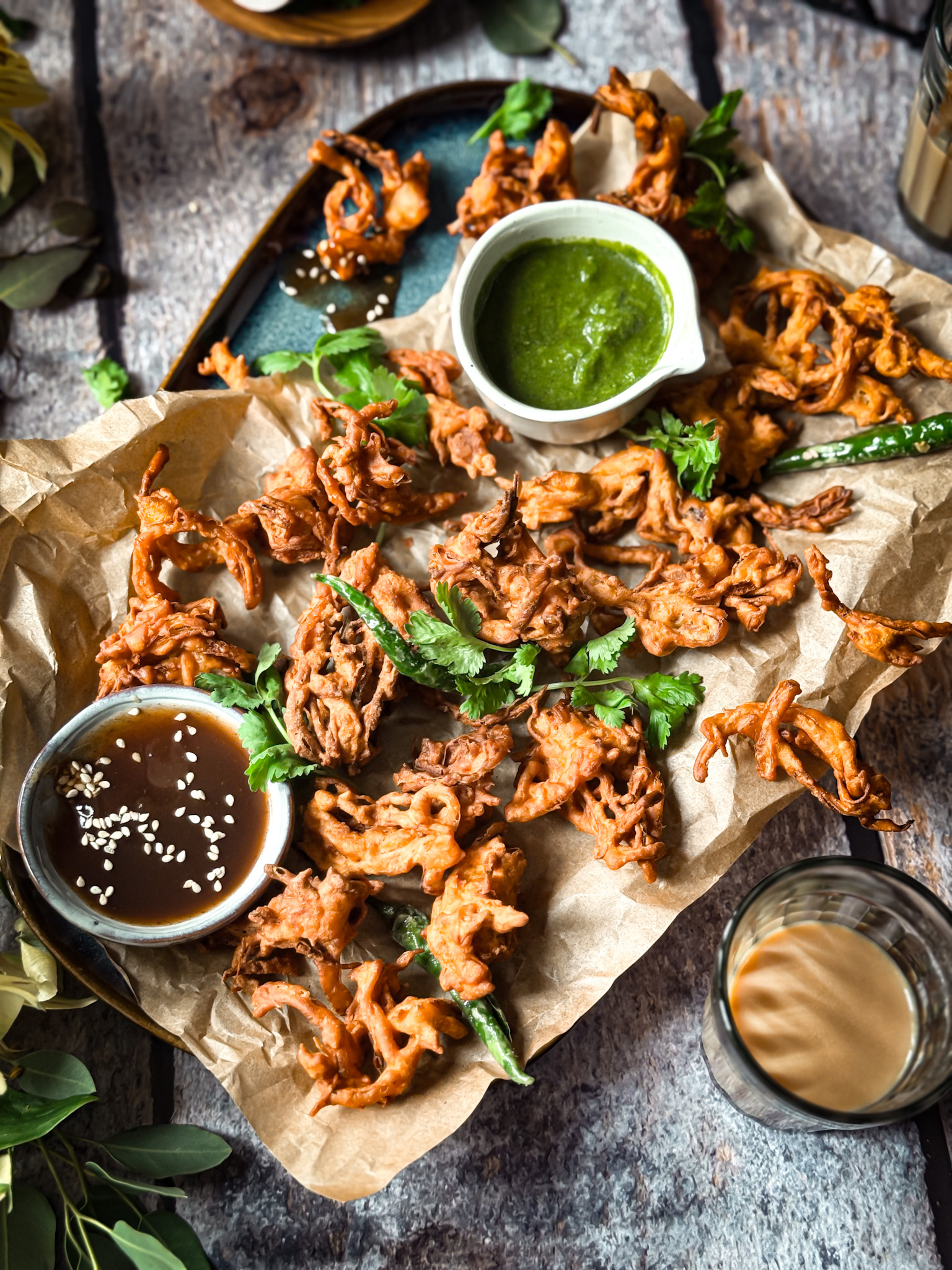
There’s something deeply familiar about onion bhajia. It’s the kind of food that doesn’t need much introduction — simple ingredients, bold flavour, and that unmistakable crisp edge that makes it difficult to stop at just one.
Unlike fully coated fritters, onion bhajia have a more irregular structure. The sliced onions cling together in strands, creating crisp edges and softer pockets throughout. That contrast is what makes them so recognisable — light in places, structured in others, never uniform.
This Crispy and Golden Onion Bhajia recipe focuses on getting that balance right. Thinly sliced onions tossed in spice and bound just enough to hold, then fried until deeply golden. Nothing complicated, nothing excessive — just a reliable method that delivers every time.
It’s a recipe that works just as well as a snack, a starter, or something to pass around with chutneys and tea. Straightforward, comforting, and always welcome, onion bhajia earn their place on the table without needing much else.
What Are Bhajias?
Bhajias are savoury fritters found across the Indian subcontinent, made by coating vegetables in a seasoned chickpea flour batter and frying them until crisp. The name comes from the act of frying itself, which is central to how they are made and enjoyed.
They are not limited to one filling. Potatoes, spinach, corn, paneer, chillies and onions are all common variations, often shaped by whatever is available in the kitchen. That adaptability is part of what makes them so enduring. A good batter, fresh ingredients and hot oil are all that is required.
The names bhaji, bhajiya and pakora are sometimes used interchangeably across different regions. They all refer to the same idea — vegetables coated, fried and served hot.
Ingredients Used
- Red onions. Thinly sliced from root to tip rather than across. The direction of the cut affects the final texture so this step matters. Standard UK red onions work perfectly well but Indian red onions tend to be slightly sharper and smaller if you can find them.
- Ginger garlic paste and green chillies. They bring warmth and fresh heat to the mixture. The kind of heat that builds quietly rather than hitting all at once.
- The spice blend. Kashmiri red chilli powder for colour and gentle warmth, red chilli powder for heat, turmeric, ajwain for its distinct aroma, amchur for a gentle tang and garam masala to round everything off. Each one is doing a specific job here.
- Black salt and lemon juice. Used lightly. Just enough to sharpen the seasoning and bring everything into balance.
- Gram flour and corn flour. Gram flour binds the onions together and gives the bhajia its body. Corn flour helps create a lighter, crisper finish. Both are necessary.
- Fresh mint and coriander. Folded through at the end for freshness and contrast. They keep the bhajia from feeling heavy.
How to Make Crispy Onion Bhajia
Step 1: Slice the onions correctly
Start by trimming off the top and the root end of each red onion.
Stand the onion upright and cut it in half from root to tip — not across the middle. This is important.
Place each half flat-side down on the board so it sits steady. Now slice each half lengthwise, following the natural curved lines of the onion. You’re looking for thin slices, but not paper-thin. If they’re too thin, the bhajia can become dense. If they’re too thick, they won’t bind properly.
Once sliced, use your hands to gently separate the layers into loose strands. This is what gives bhajia their irregular shape and crisp edges.
Transfer all the sliced onions into a large mixing bowl.
Step 2: Add the aromatics and spices (but not the salt yet)
To the onions, add the ginger garlic paste, minced green chillies, chopped coriander, red chilli powder, turmeric, ajwain, amchur, garam masala and lemon juice.
Mix everything thoroughly so the onions are evenly coated.
Avoid adding salt at this stage. Salt draws out moisture quickly, and if added too early, the mixture can become overly wet before the flour is incorporated.
While mixing, set oil in a deep wok or pan over high heat so it has time to reach the right temperature.
Step 3: Add salt and rest briefly
Now add a pinch of black salt and regular salt to taste. Mix gently to coat — do not squeeze the onions. Allow the mixture to rest for about 2 minutes. This short rest helps release just enough moisture to bind the flour naturally, without the need to add water.
Step 4 : Add the flours graduall
Add the besan and corn flour in batches, mixing as you go. The goal is to coat the onion strands lightly, not to create a smooth batter.
The exact amount of flour will depend on how much moisture your onions have released. Add just enough so that when pressed lightly in your palm, the mixture holds together loosely but still looks textured and irregular.
If using rice flour instead of corn flour, use a smaller quantity and increase the besan slightly.
Step 5: Fry carefully
The oil should be hot, around 175–185°C. If you don’t have a thermometer, drop in a small bit of mixture — it should rise steadily and bubble without browning instantly.
Just before adding the bhajia, lower the flame to medium.
Dip your fingers lightly in water to prevent sticking, then drop small, loose portions of the mixture into the oil. There’s no need to shape them precisely — irregular shapes are ideal. Flatten them slightly as they enter the oil.
Do not move or disturb them immediately. Allow the outer layer to set before turning, otherwise they may break apart.
Once set, increase the heat slightly and fry slowly until deeply golden and crisp.
Step 6: Drain and rest briefly
Remove the bhajia with a slotted spoon and place them on kitchen paper to drain.
Let them rest for a minute before serving — this allows the exterior to firm up slightly and finish crisping.
Serve hot and crisp with chutney or your preferred dip.
Helpful Tips and Tricks
- Slice from root to tip
Cutting along the natural lines of the onion creates long strands that bind properly and form crisp, irregular edges. - Separate the layers fully
Loosen the sliced onions with your hands before adding spices. Compact pieces won’t fry evenly. - Add salt at the right stage
Season after mixing the spices. This will prevent excess moisture from releasing too early and the batter becoming soggy. - Aim for coating, not batter
The flour should cling to the onions lightly. The mixture should look textured and irregular, not smooth, watery, or clumpy. - Let them set before turning
Once in the oil, allow the outer layer to firm up before moving them. This helps maintain their shape. - Maintain steady medium heat
Too hot and they brown before cooking through. Too cool and they absorb oil. - Keep the shape loose
Drop the mixture in rough portions rather than tight balls. The uneven edges are what crisp best.
Can I make onion bhajia ahead of time?
They’re best served fresh, straight from the pan. If needed, you can reheat them in a hot oven for a few minutes to restore some crispness, but they won’t be quite the same as freshly fried.
Why did my bhajia turn out soggy?
This usually happens if the oil temperature was too low or the pan was overcrowded. Fry in batches and maintain steady medium heat.
Why are my bhajia breaking apart in the oil?
The outer layer likely hasn’t set yet. Avoid turning them too early and make sure the mixture isn’t too wet.
Can I use rice flour instead of corn flour?
Yes. Use slightly less rice flour than corn flour and adjust the besan if needed. Rice flour adds extra crispness.
Can these be air fried or baked?
They can be air fried, but the texture will be different. Bhajia rely on deep frying to create their characteristic crisp edges.
Can I prepare the mixture in advance?
It’s best mixed just before frying. Once salt is added, the onions continue releasing moisture, which can affect texture if left too long.
If you make this recipe I’d love to hear how it turned out. Leave a comment below and let me know. It genuinely makes a difference to know what’s working and what isn’t, and I read every single one. You can also find me on Pinterest, Instagram and Facebook where I share new recipes, behind the scenes and whatever else is happening in the kitchen at Poetry of Spices.

Ingredients
method
(6-7 red onions)
(1 tbsp ginger garlic paste, 2-3 green chillies, 1 tbsp Kashmiri red chilli powder, ½ red chilli powder,¼ turmeric powder, 1tsp ajwain, 1tsp amchur, ½ garam masala, 1-2 tsp lemon juice)
(pinch of black salt, salt, 2 tbsp coriander, 1 tbsp mint)
( ¾ - 1 cup gram flour, 1 tbsp corn flour, water if required)
(Oil)
(Finished onion bhajia)
8 comments
This is one of the quickest and most awesome recipe for onion bhajia. They were super crisp and delicious. I love how you present your food.
Rina S
Hey Rina,
I’m delighted they were a success. And thank you for the kind words about the presentation—that means a lot.
Absolutely delish.. simple to make and packed with punch of flavour. Can I bake them ??
Kazia
Hey Kazia, So glad you enjoyed them! I haven’t tested a baked version myself, so I can’t say with confidence how they’d turn out. If you do give it a try, I’d love to hear how it goes.
Mini, your tips are always so helpful, specially when you explain when to add salt and separating the layers of the onion. Awesome ..
Evie
Thank you Evie! I’m so glad you find the tips helpful. Those little details are exactly the kind of things I wish someone had explained to me when I started cooking. Knowing when to add salt and how to handle the layers makes such a difference to the final result. Happy cooking!
Thanks for this recipe, it was my first time making bhaji and it worked beautifully despite a few substitutes and missing ingredients. I can’t stand a doughy and thick bhajia and it was really easy to make them crispy and delicious.
Amanda
Hey Amanda,
What a lovely comment. I’m delighted your first batch was such a success.