
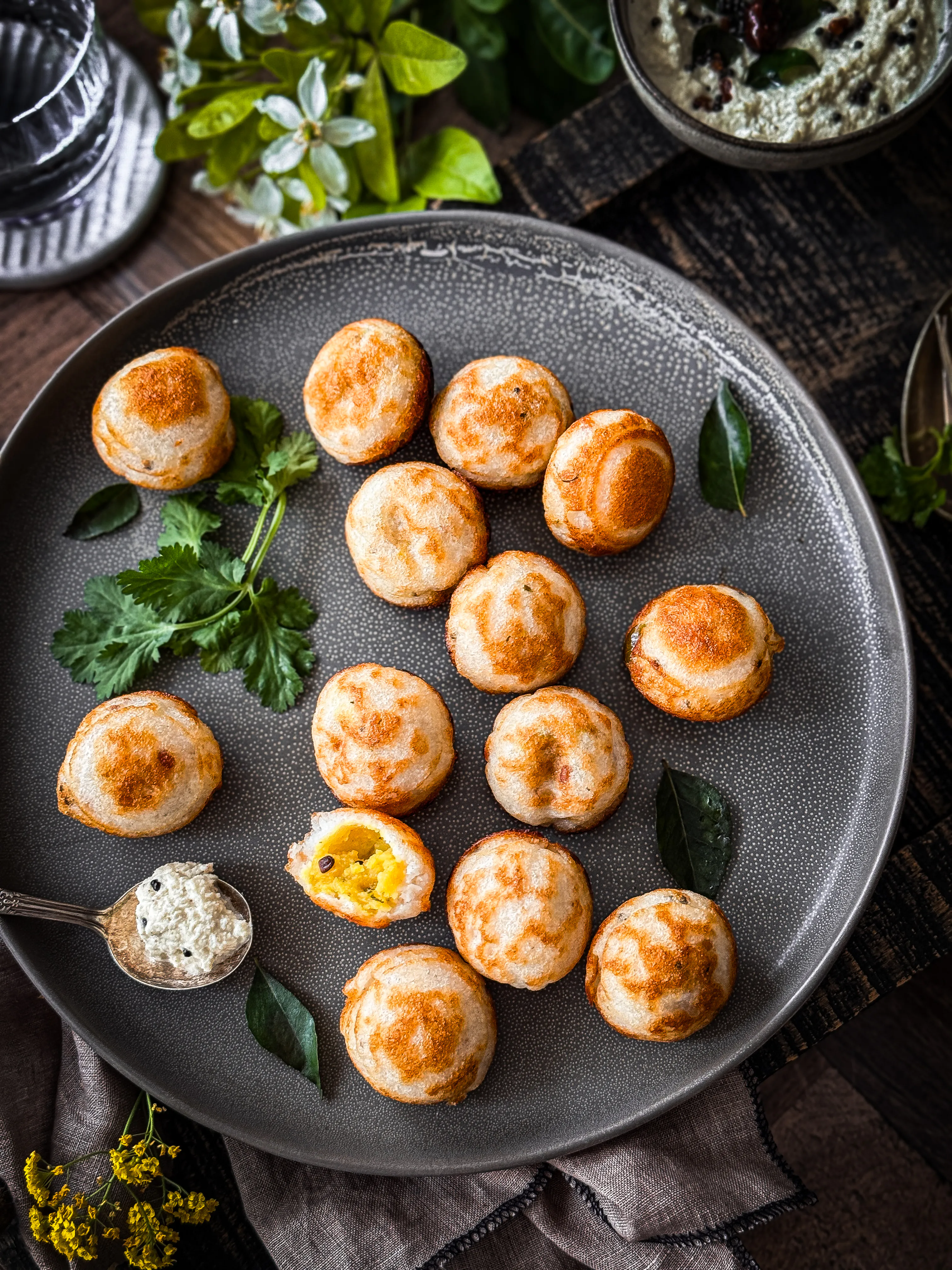
Crispy on the outside, soft and spiced within — stuffed paniyaram is the kind of thing you eat one of and immediately reach for another.
Also known as kuzhi paniyaram, this is a staple in South Indian homes. The kind of dish that shows up at breakfast or as an afternoon snack, eaten warm with coconut chutney on the side. Fermented idli dosa batter on the outside, a warmly spiced potato filling tucked inside. The batter crisps up beautifully in the pan while the filling stays soft and fragrant, and the whole thing comes together in a way that feels far more considered than the effort involved.
This is South Indian home cooking at its most honest. Unfussy, deeply satisfying, and the sort of recipe that earns a permanent spot in your kitchen once you have tried it.
What is Paniyaram?
Paniyaram is a traditional South Indian dish. Small, round dumplings with a crispy outer shell and a soft centre, made by cooking batter in a special pan with individual round moulds. That pan, known as a paniyaram pan or aebleskiver pan, is what gives each piece its shape and its evenly crisped surface. Without it, you cannot quite replicate the result.
It is a wonderfully versatile dish. Depending on the region and the household, paniyaram can be made savoury, spiced and filled, or sweetened with jaggery and coconut for something closer to a dessert. Both versions are equally at home on a South Indian table, and both start from the same place. A good batter and a well-seasoned pan.
The batter itself varies from household to household too. Some families use leftover idli dosa batter. A clever way to make sure nothing goes to waste. While others have their own special recipe that has been passed down and tweaked over generations. We are using idli dosa batter here, which is widely available and gives a beautifully light, slightly tangy result.
If you do not already own a paniyaram pan, they are easy to find online and inexpensive. Once you have one, you will find reasons to use it far more often than you expected.
A Few Good Reasons To Make This
- That crispy shell – The batter crisps up beautifully in the pan golden on both sides with a soft, spiced centre that stays tender.
- Great use of leftover batter – If you make idli or dosa regularly, this is a brilliant way to use up what is left without any waste.
- Genuinely comforting – Warm, spiced, and deeply satisfying the kind of food that feels like it has always been part of your kitchen.
- Weeknight friendly– The filling and batter come together quickly, and the cooking itself takes no time at all.
Ingredients You’ll Need
The Batter Base:
- Idli dosa batter – fermented and slightly tangy, this is what gives the shell its characteristic crispness and a flavour you cannot get from a plain batter. Shop-bought works perfectly well here.
- Coriander leaves – fresh and bright, they add a gentle herby note that lifts the batter without overpowering it.
The Tempering:
- Mustard seeds – once they hit the hot oil they splutter and release a warm, nutty aroma that sets the tone for everything that follows.
- Black peppercorns – slightly crushed to release a gentle, lingering heat rather than sharp spice.
- Curry leaves – deeply fragrant and one of those ingredients that simply cannot be substituted. A handful goes a long way.
- Urad dal & dariya dal – both turn golden in the oil and add a pleasant nuttiness and subtle crunch. Dariya dal is roasted chana dal — widely available in South Asian grocery shops, but easy to leave out if needed.
- Onion – cooked until sweet and soft, it brings a quiet richness to the tempering.
- Green chillies – fresh heat that runs through the whole dish. Use more or less depending on how much warmth you like.
For Potato Filling :
- Boiled potatoes – soft and neutral, they absorb all the flavour of the spiced tempering beautifully.
- Turmeric powder – a small amount that adds gentle earthiness and gives the filling its warm golden colour.
- Lemon juice – just enough to brighten the filling and cut through the richness of the potato.
- Salt – added to both the batter and the filling, but taste the batter first. Shop-bought idli dosa batter is often already well seasoned.
How to Make Stuffed Paniyaram
Start with the tempering. Heat the oil and add the mustard seeds and peppercorns, the moment the seeds begin to splutter, add the dals. Let them turn golden, then add the onion, curry leaves, and green chillies. If you have never cooked with curry leaves before, be ready the second they hit the oil the kitchen changes completely. Cook until the onion is soft and sweet, not just translucent. That depth is what carries the whole dish.
Now the part that makes this recipe worth reading rather than just following . Split the tempering in two. Half goes into the batter with the coriander and salt, half stays in the pan for the filling. Folding the tempered spices directly into the batter means every bite carries that flavour, not just the ones with filling in them. It is a small decision that makes a noticeable difference.
For the filling, add the turmeric and mashed potatoes to the remaining tempering, work out any lumps, then finish with coriander leaves, lemon juice and salt. Let it cool completely before rolling into balls. Warm potato will not hold its shape and will stick to everything.
To cook, grease the pan well, add a base of batter to each mould, sit a potato ball in the centre, and cover with more batter. Lid on, medium heat, and leave it undisturbed until the edges have set and the base has pulled away from the mould. Turn carefully and cook the other side to the same golden colour. Best eaten immediately the crunch does not last and it is the best part.


.
Helpful Tips and Tricks
A few things worth knowing
- Batter consistency is everything. Idli dosa batter should be pourable but with enough body to coat. It should be along the lines of a classic pancake batter. If it feels too watery and runs straight off a spoon, it will not wrap around the potato ball properly and the filling will be left exposed. A quick stir before you start is always worth doing, and if it still feels too loose, a small amount of rice flour stirred in will bring it back.
- The size of the potato ball matters more than you think. Too large and there is not enough batter to enclose it. The filling will break through as it cooks. Too small and you lose the whole point of a stuffed paniyaram. Aim for a ball roughly the size of a large marble, snug but not straining against the mould.
- Get the batter proportion right on both sides. The base layer should be just enough to coat the bottom of the mould, about half a tablespoon. Too little and the filling catches on the pan. Too much and the paniyaram turns thick and doughy rather than crisp. The top layer just needs to seal the filling in, a thin, even cover is all it takes.
- Medium heat is non-negotiable. If the heat is too high the outside will colour before the batter has cooked through. Medium and steady is what gives you that evenly crisped shell all the way around.
- Do not turn too early. Wait until the edges look fully set and the base has visibly pulled away from the mould. If it resists when you try to turn it, it is not ready – give it another minute and try again.

.
1. Can I make the batter and filling ahead of time?
Yes — and it is a good way to make this feel effortless on the day. The potato filling keeps well in the fridge for up to two days. The batter keeps for up to three, and some say it actually improves as the fermentation continues. When you are ready, roll the filling into balls and cook straight from the fridge — fresh from the pan every time with very little effort.
2. I don’t have a paniyaram pan — can I use something else?
The pan is really what makes this dish — the round moulds are what give each piece its shape and that evenly crisped surface. An aebleskiver pan works in exactly the same way and is widely available online. Without either, you could cook the batter as small patties in a non-stick pan, though the texture and look will be quite different.
3. Can I use homemade batter instead of shop-bought?
Absolutely — and if you make idli or dosa regularly, this is a brilliant way to use up any leftover batter. Homemade batter that has had a good ferment will give you a slightly tangier, more complex flavour. Just make sure it has had enough time to ferment properly before using.
4. What else can I serve this with besides coconut chutney?
Tomato chutney works particularly well with the spiced potato filling. Sambar — a South Indian lentil broth — is another classic alongside if you want something more substantial. A simple mint and coriander chutney is a good option too if you want something fresher and brighter on the side.
Ways to make it your own
Why stop at one? Try it with a spiced paneer filling, stuff it with chilli cheese corn for a crispy melty twist, or skip the tempering entirely and go sweet with coconut and jaggery. The batter stays the same — the rest is yours to explore.
Spiced Paneer
All the warmth of the original — same tempering, same familiar spices — but with crumbled paneer in place of potato. Richer, creamier, and just as good. Once you try it you will want to make both and let everyone pick their favourite.
Chilli Cheese Corn
Everything you love about chilli cheese toast — the sweetness of the corn, the heat of the chilli, that melted cheese pull — tucked inside a crispy paniyaram shell. It has nothing to do with tradition and everything to do with the fact that it works beautifully.
Sweet Coconut & Jaggery
Leave the tempering out of the batter and fill it with freshly grated coconut, jaggery, and a whisper of cardamom. Warm, gently sweet, and proof that this little pan is capable of a lot more than you might expect.
If you make this recipe I’d love to hear how it turned out. Leave a comment below and let me know. It genuinely makes a difference to know what’s working and what isn’t, and I read every single one. You can also find me on Pinterest, Instagram and Facebook where I share new recipes, behind the scenes and whatever else is happening in the kitchen at Poetry of Spices.

Ingredients
For the batter
For the tempering
For the potato filling
method
(1 tsp neutral oil • ½ tsp mustard seeds • 5–6 black peppercorns, slightly crushed • 1 tsp urad dal • 1 tbsp dariya dal, slightly pounded • 1 medium onion, finely chopped • 12–15 curry leaves • 2 green chillies, chopped)
(2 cups idli dosa batter • 1 tbsp coriander leaves • salt, to taste)
(4 medium boiled potatoes, mashed • ¼ tsp turmeric powder • ½ tbsp lemon juice • salt, to taste)
(Prepared batter • prepared potato balls • oil, for greasing)
(Coconut chutney, for serving)
14 comments
Greetings from Australia Mini! This morning I had the opportunity to make these delicious paniyaram and I followed your instruction to the letter. Absolutely delicious. Beautiful combination of flavours, and perfect for breakfast.
Anisha
Hey Anisha,
Really happy these worked out for you, and that they hit the mark for breakfast. Thank you for letting me know, always nice to hear from Australia.
I loved making these, have been wanting to make these for a long time. They were crispy on the outside and soft from the inside. Delish..
Aashi
Hey Aashi,
I’m so glad you finally got around to making them. It sounds like they were worth the wait!
My new favourite appetiser. Every time I make them they’re a hit. Super easy. Thank you so much.
Kerri
Thank you so much, Kerri! I love that these have become a regular in your kitchen, they’re always such a fun bite to make. So glad they’re such a hit every time!
Hi, Can you please give the recipe for the batter also. Would love to try this recipe but cannot find batter at my local store.
Jagruti Muchal
Hi Jagruti, thank you so much for wanting to try it! The batter is a classic idli-dosa batter, ready-made ones can usually be found in the fridge section of Indian grocery stores labelled ‘idli dosa batter’. I’ll try to put up a batter recipe on the blog soon for those who can’t find it locally.
Hello from Leeds, I’d love to try this recipe. Where can I buy the paniyaram pan in UK. Thanks
Shamita Paul
Hi Shamita, you can buy it from any Indian store or on Amazon.
What a brilliant twist on classic paniyaram. I made these for brunch and everyone was so surprised by the spiced potato filling in the middle. Such a fun recipe!
Radhika J
Hi Radhika, I am so pleased they were a hit.
I made these yesterday for a family gathering and everyone loved them. Such a simple and delicious recipe.
Jaya
Hey Jaya, feeding a crowd and getting the seal of approval is always the best feeling! Thank you so much for making them.