
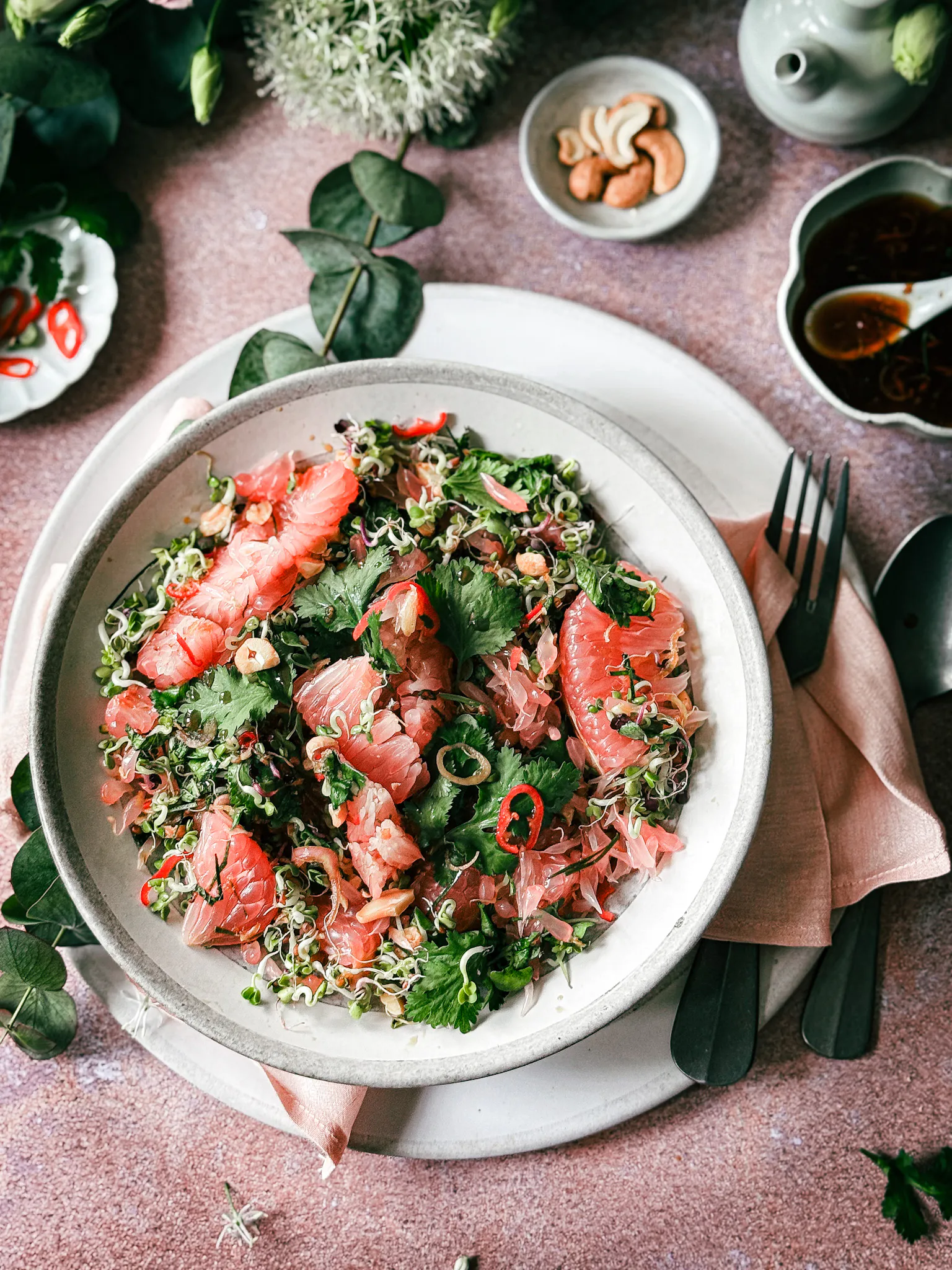
Bright, juicy pomelo. Crunchy toasted coconut. A citrus-soy dressing with just enough chilli to keep things interesting. This Thai Pomelo Salad is the kind of dish that wakes up your plate without making a fuss about it.
Pomelo is the largest of the citrus fruits, related to grapefruit but noticeably sweeter and less bitter, with a texture that holds up beautifully when torn into pieces rather than cut. That texture is part of what makes it so good in a salad — each piece is juicy and substantial, soft enough to absorb the dressing but firm enough to keep its shape. If you have never cooked with it before, this is a very good place to start.
The salad plays with contrast at every turn. Salty, sweet, tangy and sharp in all the right places, with the toasted coconut and roasted peanuts adding crunch against the soft citrus. Kaffir lime leaves and lemongrass woven through give it that unmistakable Thai fragrance that is difficult to describe and very easy to recognise. Inspired by the bold, balanced flavours of Thai street food, this version brings that feeling home in the simplest way.
Why You’ll Love this Recipe
- Every bite is different. Juicy pomelo, crunchy coconut, soft herbs, a punchy dressing. The contrast of textures is what makes this salad so compelling.
- Twenty minutes from start to finish. The dressing takes two minutes in a mortar and pestle. The rest is assembly.
- Fully plant-based. Made with vegan fish sauce, so every ingredient is plant-based without compromising the flavour.
- Rooted in Thai street food. The flavour balance of this salad — salty, sweet, sour, hot — is the hallmark of Thai cooking at its best.
Ingredients Used
THE SALAD
- Pomelo. Torn into chunks rather than cut, so the flesh stays light and juicy rather than compressed. Sweet and fragrant, far less bitter than grapefruit, and the star of the whole salad. See the video for how to peel and prepare it.
- Toasted coconut. Dark-toasted for a deep, nutty flavour and a crunch that holds up well in the dressing.
- Roasted peanuts. Coarsely ground so they scatter through the salad and add nuttiness in every bite rather than sitting in a pile.
- Shallots. Thinly sliced for a sharp, savoury note that runs through the salad without overpowering the citrus.
- Kaffir lime leaves. Very finely julienned, the thinner the better. They add a floral, citrusy fragrance that is one of the defining aromas of Thai cooking.
- Lemongrass. Bottom half only, very thinly sliced. It brings a clean, grassy lemon note that is quite unlike any other ingredient.
- Fresh mint and coriander. Added at the end for freshness and colour. The coriander is optional if you prefer to leave it out.
- Wild betel leaves (optional). Also known as chaploo leaves, they are traditionally served alongside so you can wrap a little of the salad inside for a single fragrant bite. Worth seeking out if you can find them.
THE DRESSING
- Palm sugar. Dissolved in the mortar first to form the sweet base of the dressing. Light brown sugar works as a substitute if palm sugar is hard to find.
- Lime juice. Sharp and citrusy, it is the acidic backbone of the dressing and brings brightness to everything it touches.
- Vegan fish sauce. Adds the salty, savoury depth that gives the dressing its umami character. Widely available in Asian grocery shops and larger supermarkets.
- Red chilli. Finely minced and pounded into the dressing. Adjust the amount to suit your heat preference.

How to Make It
Make the dressing first. In a mortar and pestle, pound the chilli into a rough paste. Add the palm sugar and pound until it dissolves into the chilli. Pour in the vegan fish sauce and lime juice and swirl to combine. The dressing should taste balanced — salty, sweet, sharp and just a little hot. Adjust any element to taste before it goes on the salad.
Assemble the salad. Pour the dressing into a large mixing bowl. Add the pomelo chunks, toasted coconut, ground peanuts, shallots, kaffir lime leaves, lemongrass, mint and coriander. Toss gently to combine, taking care not to crush the pomelo as you mix.
To serve, transfer to a plate or bowl and eat straight away while the pomelo is fresh and the coconut still has its crunch. If you have wild betel leaves, lay them alongside so guests can wrap a little of the salad inside each leaf for a single, fragrant mouthful.
Helpful Tips and Tricks
- Tear the pomelo, do not cut it. Tearing the flesh into chunks rather than slicing it keeps the texture light and airy. Cut pomelo tends to compress and lose some of its juiciness, which changes the whole character of the salad.
- Taste the dressing before it goes on. The balance of the four elements — sweet, salty, sour and hot — is what makes this dressing work. Taste it before tossing and adjust whichever element feels off. A little more lime if it needs sharpness, a touch more palm sugar if it feels too sharp.
- Dress it just before serving. The pomelo releases juice once dressed and the coconut begins to soften. Toss everything together at the last possible moment so the textures stay distinct.
- Slice the kaffir lime leaves as finely as you can. They are tough enough to be unpleasant if left in thick strips. Very fine julienne means the flavour and fragrance come through in every bite without the texture becoming intrusive.
- Toast the coconut until it is properly dark. Lightly toasted coconut has much less flavour than coconut that has gone all the way to a deep golden brown. Watch it closely in the pan — it catches quickly, but the flavour at that darker stage is worth the attention.
Q: Where do I find pomelo and what does it taste like?
A: Pomelo is widely available in Asian grocery shops and increasingly in larger supermarkets, particularly in autumn and winter when it is in season. It is the largest of the citrus fruits and related to grapefruit, but noticeably sweeter and far less bitter. The flesh is pale yellow or pink, dry rather than juicy in the way of an orange, and separates cleanly into large, satisfying pieces when torn apart. If you cannot find it, grapefruit is the closest substitute, though the flavour will be more bitter and the texture wetter.
Q: What is vegan fish sauce and where do I find it?
A: Vegan fish sauce replicates the salty, umami depth of traditional fish sauce using plant-based ingredients such as seaweed, mushrooms and soy. It has become widely available in Asian grocery shops and health food stores. If you cannot find it, a mixture of soy sauce with a small amount of seaweed or nori dissolved in it will get you close to the same depth of flavour.
Q: Can I make this ahead of time?
A: The dressing keeps well in the fridge for up to three days and the salad components can all be prepared ahead and stored separately. The one thing you cannot do in advance is toss everything together — once dressed, the pomelo releases juice, the coconut softens and the salad loses its contrast of textures. Assemble and toss immediately before serving.
Q: What are wild betel leaves and do I need them?
A: Wild betel leaves, also known as chaploo leaves, are a herb used widely in Thai cooking with a distinctive peppery, slightly anise-like flavour. They are served alongside the salad so you can wrap a little of the mixture inside each leaf for a single fragrant bite — a traditional way of eating this dish. They are available in Thai and South East Asian grocery shops. They are not essential and the salad is complete without them, but if you can find them they add an extra dimension that is very much in the spirit of the original.
Looking for more Asian salad recipes ?? Here are few of our favourites
Glass Noodle Salad with Sichuan Dressing
Asian Edamame and Quinoa Salad
If you make this recipe, I’d love to hear how it turned out. Leave a comment below and let me know, it genuinely makes a difference to know what’s working and what isn’t, and I read every single one. You can also find me on Pinterest, Instagram and Facebook, where I share new recipes, behind the scenes moments, and whatever else is happening in the kitchen at Poetry of Spices.

Ingredients
The salad
- 2 cups pomelo, torn into chunks
- 3 tbsp shredded coconut, dark toasted
- 2 tbsp roasted peanuts, coarsely ground
- 3 tbsp shallots, thinly sliced
- 2 kaffir lime leaves, very finely julienned
- 2 inches lemongrass, bottom half only, very thinly sliced
- ¼ cup fresh mint leaves
- ¼ cup fresh coriander leaves (optional)
- Wild betel leaves for serving (optional)
The dressing
- 1 tbsp palm sugar
- 1½ tbsp lime juice
- 2 tsp vegan fish sauce
- 1 red chilli, finely minced
method
- In a mortar and pestle, pound the chilli into a rough paste. Add the palm sugar and pound until dissolved. Stir in the vegan fish sauce and lime juice, then taste and adjust if needed.
(1 red chilli, 1 tbsp palm sugar, 2 tsp vegan fish sauce, 1½ tbsp lime juice) - Pour the dressing into a large mixing bowl. Add the pomelo, toasted coconut, peanuts, shallots, kaffir lime leaves, lemongrass, mint and coriander. Toss gently until everything is evenly coated, taking care not to break up the pomelo.
(2 cups pomelo, 3 tbsp toasted coconut, 2 tbsp roasted peanuts, 3 tbsp shallots, 2 kaffir lime leaves, 2-inch piece lemongrass, ¼ cup mint, ¼ cup coriander) - Transfer to a serving plate and enjoy immediately while the coconut is still crisp. Serve with wild betel leaves alongside, if using.
(Wild betel leaves, optional)