
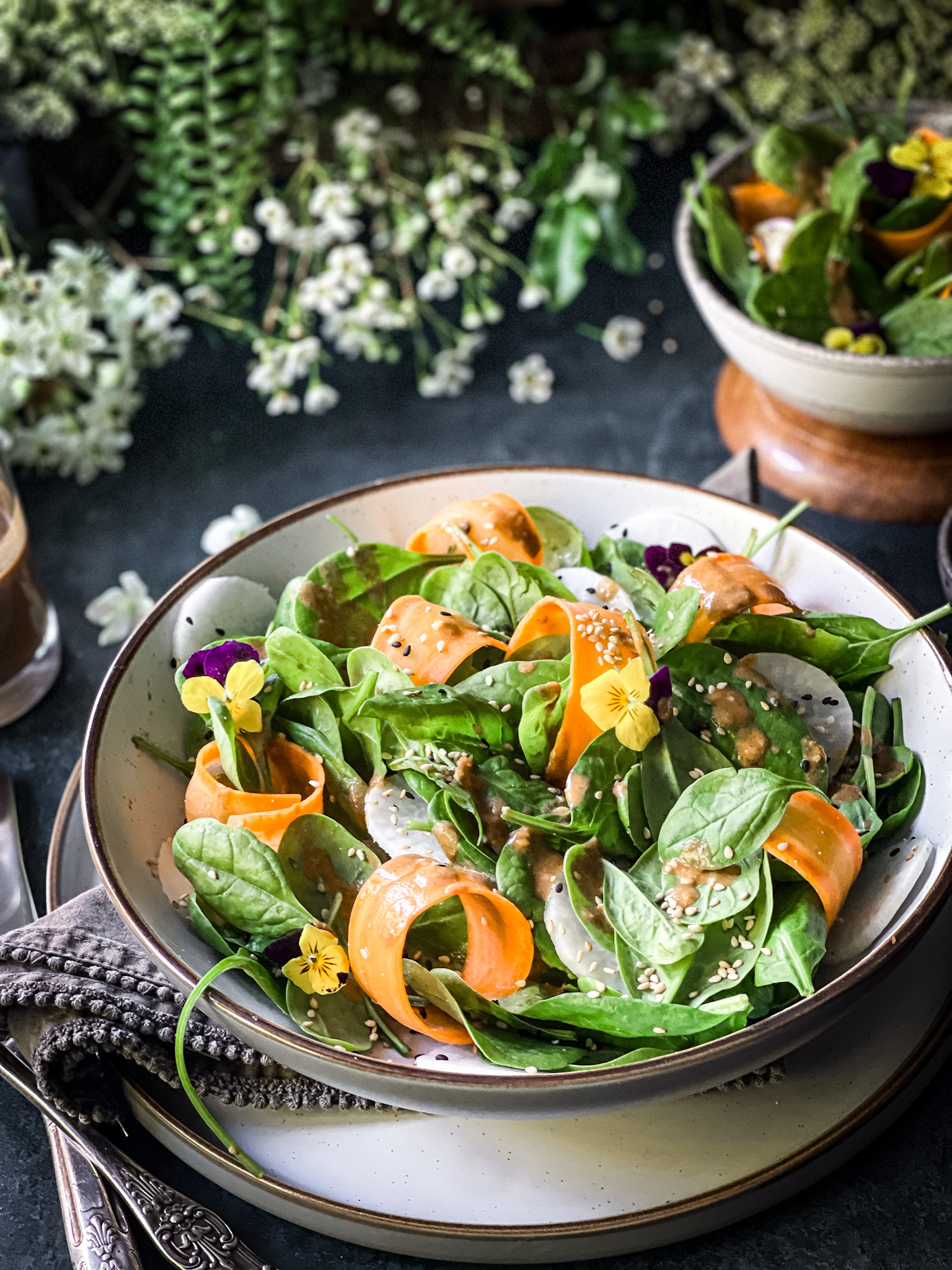
Some recipes become reflexes. This is one of them.
I make this baby spinach salad with sesame dressing so often that I probably have the time down to less than ten minutes at this point. It started as something I tried at a restaurant and couldn’t stop thinking about afterwards. There was something about the way the sesame dressing settled into the spinach. Nutty, luscious and rich in a way that felt far more considered than the ingredients suggested. I went home and started working out how to recreate it.
If you haven’t cooked with sesame paste before, this is a good place to start. It brings a depth and richness to a dressing that olive oil and lemon alone never quite achieve. Combined with fresh spinach, a little crunch and bursts of colour throughout, it delivers something that feels like considerably more than a side salad.
Vegan, dairy free and gluten free. Ready in under fifteen minutes your first time. Less than ten once it becomes a reflex. And it will become a reflex. That I can promise you.
What’s the Difference Between Sesame Paste and Tahini ?
Sesame paste and tahini are similar in that they both involve ground sesame seeds, but there are some distinctions between the two:
The biggest difference is that tahini contains lightly toasted hulled seeds. Whereas sesame paste uses unhulled dark toasted sesame seeds resulting in a much nuttier flavour and darker colour.
Tahini
Tahini (tahina or tahin) is a condiment made from lightly toasted, hulled white sesame seeds. For traditional Middle Eastern tahini, sesame seeds roast on a large stone bed fuelled by a wood-fired furnace. The toasted seeds get ground into a delicious smooth paste.Tahini paste has a deliciously mild nutty flavour. Although some shop-bought tahini can have a slightly bitter taste. Despite this, it remains hugely popular in Middle Eastern cuisine and serves as a key ingredient in mezze dishes. Notably, it takes centre stage in well-known delicacies like hummus and baba ghanoush.
Sesame Paste
Sesame paste is a common ingredient in Asian cuisines. It’s similar to tahini in its production but not as similar in taste. Chinese sesame paste often contains unhulled sesame seeds and furthermore the seeds are toasted until dark brown in colour.
The texture is equally rich and creamy but it has a much darker colour and nuttier flavour. The taste is similar to dark roasted peanut butter with skins. Chinese sesame paste, or neri goma in Japanese, is a popular ingredient in Chinese and Japanese cuisine. It is also common in Indian sweet dishes.
In summary, both sesame paste and tahini originate from sesame seeds, but the crucial distinctions emerge from the utilization of sesame seed types (toasted for tahini) and the flavor profile (toasting renders tahini nuttier).

.
Ingredients Used
Firstly, the Salad
- Baby spinach (recommended for better taste and texture)
- Daikon (long white Japanese radish) or any other radish variety
- Carrots (sliced using a vegetable slicer and soaked in ice-cold water)
Now, For the Dressing
- Chinese sesame paste – adds a rich and nutty flavour to the dressing. If unavailable, substitute with 1 part sesame oil and 4 parts tahini.
- Rice Vinegar – Rice vinegar offers a mild and slightly sweet acidity, contributing to the dressing’s tanginess and balance of flavours.
- Light Soy Sauce – brings a savoury umami element to the dressing, enhancing its depth and adding a subtle saltiness. For vegan dressing substitute with tamari sauce.
- Maple syrup – Maple syrup lends a natural sweetness to the dressing, counterbalancing the acidity and providing a hint of complexity.
- Ginger – Ginger infuses a warm and aromatic quality into the dressing, introducing a touch of spiciness and depth.
- Garlic – Garlic offers a pungent and savoury essence which enhances the overall savoury character of the dressing.
- Sesame Oil – Sesame oil amplifies the sesame flavour profile, contributing a rich and distinctive nuttiness to the dressing.
- Yuzu juice – Yuzu juice or lemon juice provides a bright citrusy note, adding freshness and a tangy element to the dressing.or substitute with fresh lemon juice)
How to Make Baby Spinach Salad
1. Prepare the greens
Wash the baby spinach well and pat it completely dry — water will dilute the dressing, and we want each leaf to hold onto flavour.
2. Make the sesame dressing
In a small bowl, whisk together sesame paste, rice vinegar, soy sauce, sesame oil, maple syrup, ginger, garlic, and citrus juice until smooth and creamy. Add water, a spoon at a time, until it loosens into a glossy, pourable sauce
3. Toss the salad
In a large bowl, combine the spinach, sliced carrot, and daikon. Pour over the sesame dressing and toss gently until everything glistens and the vegetables are evenly coated.
4. Finish and serve
Scatter roasted sesame seeds over the top and serve cold. A salad that’s crisp, nutty, tangy, and bright all at once.
Enjoy this delightful and nutritious salad as a side dish or a light meal on its own, savouring the harmonious blend of flavours and textures created by the fresh vegetables and the flavourful sesame dressing.
Helpful Tips and Tricks
- Baby spinach for flavour and texture
Choose baby spinach over mature leaves whenever you can. It’s tender, milder in flavour, and adds a delicate freshness that makes the salad feel light yet satisfying. - Chinese sesame paste vs. tahini
Can’t find Chinese sesame paste? Blend 1 part sesame oil with 4 parts tahini for a quick substitute. It mimics the rich, nutty depth beautifully while keeping the dressing smooth. - Keeping radishes crisp
Daikon is a long, white Japanese radish with a gentle bite, but any radish will do here. Slice your carrot and radish thinly with a peeler or mandoline, then plunge them into ice-cold water — it keeps them extra crisp and lively for the salad. - Yuzu swaps
Yuzu juice has a distinct, floral citrus kick. If you don’t have it to hand, lemon juice makes an excellent stand-in, bringing the same brightness and tang. - Toast the sesame seeds
Take a minute to toast the sesame seeds before sprinkling them on. The aroma blooms, the flavour deepens, and it turns a garnish into something unforgettable.
Looking for more Salad Recipes ?? Here are few of our favourites
Roasted Carrot and Cauliflower Salad with Zesty Tahini
Quick Cucumber Salad with Soy-Sesame Dressing
Easy Watercress and Apple Salad
If you make this recipe I’d love to hear how it turned out. Leave a comment below and let me know. It genuinely makes a difference to know what’s working and what isn’t, and I read every single one. You can also find me on Pinterest, Instagram and Facebook where I share new recipes, behind the scenes and whatever else is happening in the kitchen at Poetry of Spices.

Ingredients
For the salad
For the dressing
method
Wash the spinach and pat completely dry so the dressing clings to every leaf. Slice the carrot and daikon into thin, delicate strips.
(200 g spinach, 1 carrot, ½ cup daikon)
In a small bowl, whisk together the sesame paste, rice vinegar, soy sauce, sesame oil, maple syrup, ginger, garlic, and yuzu juice until smooth. Add water, a spoon at a time, until it becomes a glossy, pourable sauce.
(3 tbsp sesame paste, 2 tbsp rice vinegar, 2 tbsp soy sauce, 1 tsp sesame oil, 1 tsp maple syrup, 1 tsp ginger, 1 garlic clove, 1 tsp yuzu/lime juice, 1–2 tbsp water)
Place spinach, carrot, and daikon in a large bowl. Pour over the sesame dressing and toss gently until the vegetables are evenly coated and glistening.
(prepared greens, sesame dressing)
Scatter roasted sesame seeds over the top for crunch and nutty depth. Serve cold as a refreshing side.
(2 tbsp roasted sesame seeds)
2 comments
This was great. I used tahini , and it worked perfectly! Awesome!
Gunjan
Thank you Gunjan.