
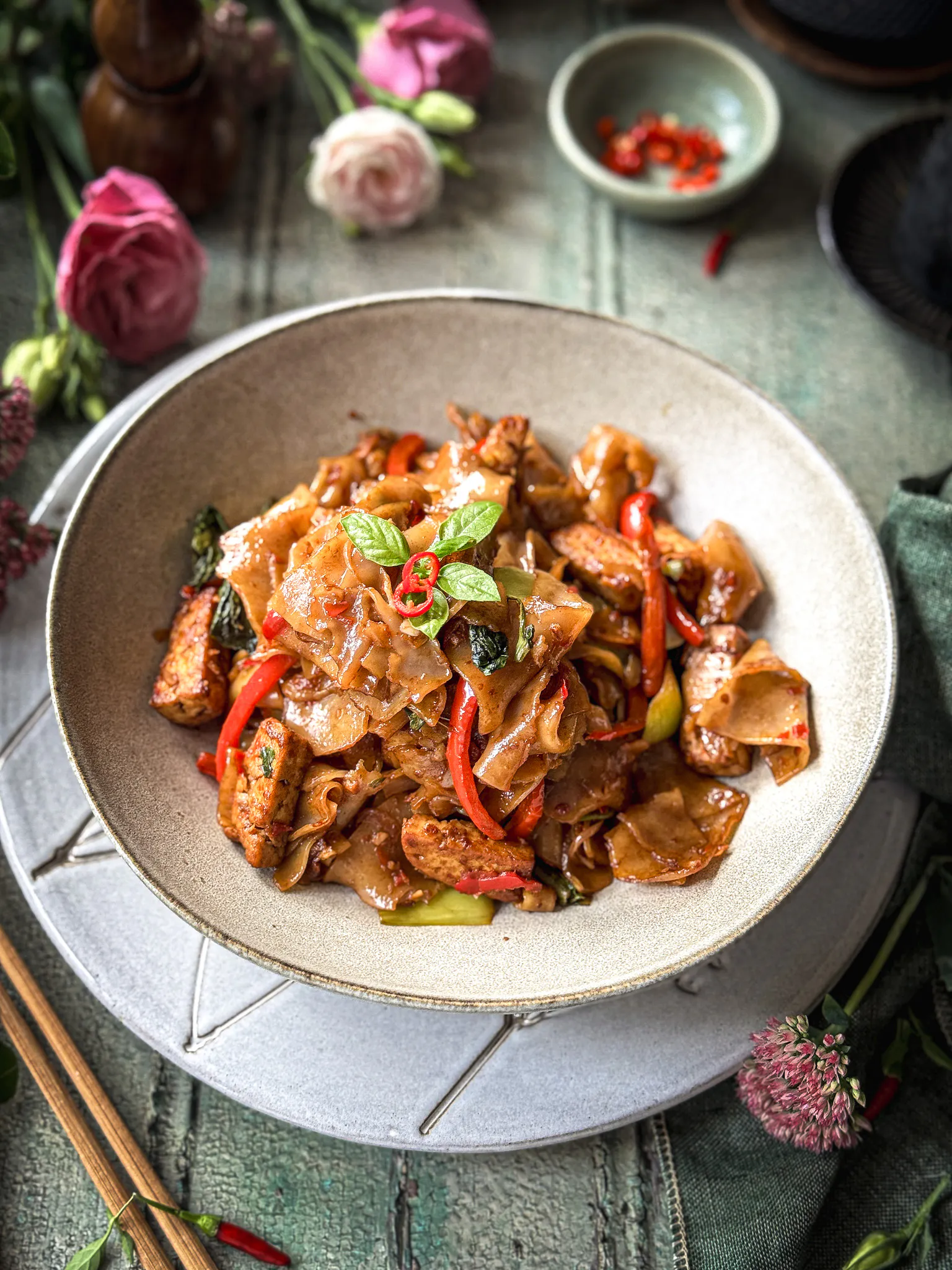
Pad Kee Mao (ผัดขี้เมา), better known as Thai Drunken Noodles, is a popular Thai street food dish known for its fiery heat, bold flavours and the unmistakable aroma of fresh basil. Made with wide, chewy rice noodles stir-fried over high heat, it’s one of those dishes that delivers without needing a long list of ingredients.
Despite its name, there’s no alcohol in Drunken Noodles! The name is said to come from how well the dish goes with a drink, or from its reputation as a favourite late-night meal. Whatever the story, it’s a dish with plenty of character.
The real appeal lies in the contrast of textures and flavours. Soft, chewy noodles with lightly charred edges, a savoury sauce that clings to every bite and a slow build of heat from the chillies. A generous handful of fresh basil added towards the end brings everything together, giving the dish its distinctive fragrance.
This vegetarian Pad Kee Mao brings together tofu, fresh vegetables and wide rice noodles in a rich, flavourful sauce. It’s a satisfying, fuss-free meal that comes together in minutes once the preparation is done, and one that’s well worth making at home.
Why You’ll Love This Recipe
- Ready in under 30 minutes. Most of the work is in the preparation. Once everything is chopped and the sauce is mixed, the actual cooking takes just a few minutes.
- Easy to make your own. Adjust the chillies to suit your taste, swap in your favourite vegetables or change the protein depending on what you have.
- A complete meal in one pan. With tofu, vegetables and noodles together, it doesn’t need much else alongside it.
What You’ll Need
For the Noodles
Fresh Rice Noodles (Ho Fun). Wide, flat rice noodles are the heart of Pad Kee Mao. Their soft, slightly chewy texture makes them ideal for stir-frying, as they soak up the sauce while retaining their texture. Fresh noodles give the best results, but dried wide rice noodles can also be used.
Tofu. Firm or extra-firm tofu works best as it holds its shape during stir-frying. Searing it separately gives it a lightly golden exterior before adding it back to the wok.
Pak Choy. Adds freshness and a little crunch. Keep the stems and leaves separate, as the stems need longer to cook while the leaves only need a quick toss at the end. Chinese broccoli (gai lan) makes a great alternative.
Onion and Red Pepper. Bring natural sweetness and a little crunch to balance the stronger flavours. The vegetables are flexible, carrots, young peppercorns, or mushrooms are also good additions.
Garlic and Chillies. Using both milder red chillies and fiery Thai chillies gives the dish plenty of flavour without relying entirely on heat. Pounding them with garlic in a mortar and pestle releases their aromatic oils, creating a fragrant paste that forms the base of the stir-fry.
Thai Basil. Traditionally, Pad Kee Mao is made with holy basil, which has a more peppery flavour. Thai basil is a good alternative, with a slightly sweet, anise-like aroma. Add it towards the end to preserve its fragrance.
Neutral Oil. Use a neutral oil with a high smoke point, such as sunflower, vegetable or rapeseed oil, for stir-frying over high heat.
Salt. A small pinch helps season the tofu as it cooks. Taste the finished noodles before adding more, as the sauces already contain plenty of salt.
For the Sauce
Vegetarian Oyster Sauce. Usually made with mushrooms, this adds a rich, savoury depth to the sauce.
Light Soy Sauce. Provides saltiness and helps season the noodles without overpowering the other flavours.
Thick Dark Soy Sauce. Adds a deep colour and richness to the noodles. Some thick dark soy sauces are sweetened, so check the label, as they can differ from regular dark soy sauce.
Vegetarian Fish Sauce. Adds another layer of savoury flavour while keeping the dish vegetarian.
Palm Sugar. Balances the salty and spicy flavours with a gentle sweetness. Brown sugar makes a convenient substitute.
Why use two types of chillies in Pad Kee Mao?
There’s more to the chillies than the heat. Using two varieties builds depth without making the noodles overwhelmingly hot.
The larger red chillies are generally milder, adding freshness and colour, while the smaller Thai chillies bring the fiery kick. Using only Thai chillies would make it hard to get the same depth without too much heat.
Pounding both with garlic makes a difference too. It releases their natural oils and makes a coarse, fragrant paste that spreads evenly through the noodles as they cook. You can always change the number of Thai chillies depending on how much heat you enjoy.
How To Make It
Prepare the vegetables and tofu. Slice the onion, red pepper and pak choy, keeping the stems and leaves separate as they cook at different speeds. Cut the tofu into bite-sized pieces and set aside.
Make the chilli and garlic paste. Using a mortar and pestle, pound both varieties of chillies with the garlic until you have a coarse paste. This helps release their natural oils and brings out their flavour.


Prepare the noodles and sauce. Cut the fresh Ho Fun noodle sheets into wide strips and gently separate them. If they’re sticking together, warm them briefly to help loosen the sheets. In a separate bowl, combine all the sauce ingredients and stir until the sugar dissolves. Have everything ready before you start cooking, as the stir-frying moves quickly.
Sear the tofu. Sear the tofu. Heat the oil in a hot wok. Add the tofu, season with a pinch of salt and a splash of light soy sauce, and sear for 5–6 minutes until lightly golden. Remove from the wok and set aside.


Stir-fry the vegetables. Add more oil to the wok if needed, followed by the chilli and garlic paste. Stir-fry for a few seconds until fragrant, then add the onion, red pepper and pak choy stems. Cook for a few minutes, keeping the vegetables slightly crisp, before returning the tofu to the wok.
Add the noodles and sauce. Tip in the rice noodles and pour over the prepared sauce. Toss gently over high heat until everything is evenly coated. Let the noodles sit briefly against the hot wok to develop some char before tossing again. Avoid stirring too vigorously, as fresh rice noodles can break easily.


Finish with fresh basil. Add the pak choy leaves and Thai basil, tossing everything together just until the leaves wilt. Serve immediately while the noodles are hot and glossy.
Helpful Tips & Tricks
- Use fresh rice noodles whenever possible. Fresh Ho Fun noodles have a soft, springy texture that dried noodles can’t replicate. If they’re refrigerated and stuck together, warm them gently before separating to prevent tearing.
- Cook in smaller batches. Overcrowding the wok traps steam, making the noodles soft and sticky rather than lightly charred. If you’re making several portions, cook them in batches for better results.
- Keep the heat high. A properly heated wok helps the vegetables keep their crunch and gives the noodles caramelised edges. Once the noodles are coated in sauce, leave them undisturbed briefly before tossing again.
- Lift rather than stir. Fresh rice noodles are delicate, so use a wide spatula to lift and turn them instead of stirring constantly.
- Add the basil right at the end. Thai basil loses its fragrance when cooked for too long, so toss it through just before switching off the heat.
Q: Can I use dried rice noodles instead of fresh?
A: Yes. Dried wide rice noodles work if you can’t find fresh Ho Fun, although the texture is less soft and springy. Cook them according to the packet instructions, but stop slightly early, as they’ll keep softening in the wok.
Q: How can I make Pad Kee Mao vegan?
A: It’s already vegetarian, and it’s vegan as long as every sauce is plant-based. Check the labels on the vegetarian oyster sauce and fish sauce. If you can’t find a vegan vegetarian fish sauce, use a little extra light soy sauce, although the flavour will be slightly different.
Q: Can I make Pad Kee Mao less spicy?
A: Yes. Use fewer Thai chillies, or leave them out, and keep the larger red chillies for their flavour and colour, choosing a mild variety.
Q: How do I store and reheat leftovers?
A: Pad Kee Mao is best fresh, as rice noodles lose their texture once refrigerated. Let leftovers cool, then keep them in an airtight container in the fridge and eat them the next day. Reheat in a non-stick pan with a splash of water, tossing until piping hot, or in the microwave, stirring halfway through. Reheat only once.
Looking for More Noodle Recipes ?? Here are few of our Favourites:
Quick Teriyaki Noodles with Vegetables
Easy Spicy Udon Noodles with Thai Basil
If you make this recipe I’d love to hear how it turned out. Leave a comment below and let me know. It genuinely makes a difference to know what’s working and what isn’t, and I read every single one. You can also find me on Pinterest, Instagram and Facebook where I share new recipes, behind the scenes and whatever else is happening in the kitchen at Poetry of Spices.

Ingredients
For the Noodles
- 2–3 pak choy, stems and leaves separated, sliced
- ½ brown onion, thinly sliced
- ½ red bell pepper, sliced
- 100g firm tofu, cut into bite-sized pieces
- 2 red chillies, roughly chopped
- 2–3 Thai Red Birds eye chillies, adjust to taste
- 6 garlic cloves, peeled
- 450g fresh wide rice noodles (Ho Fun)
- 3 tbsp neutral oil, plus extra if needed
- Salt, to taste
- A splash of light soy sauce, for the tofu
- 1 handful fresh Thai basil
For the Sauce
- 2 tbsp vegetarian oyster sauce
- 1 tbsp light soy sauce
- 1 tbsp thick dark soy sauce
- 1 tbsp vegetarian fish sauce
- 1½ tbsp palm sugar or brown sugar
method
- Prepare the vegetables and tofu. Slice the onion, red pepper and pak choy, keeping the stems separate from the leaves. Cut the tofu into bite-sized pieces.
(2–3 pak choy, ½ brown onion, ½ red bell pepper, 100g firm tofu) - Make the chilli paste. Add both varieties of chillies and the garlic to a mortar and pestle. Pound into a coarse paste and set aside.
(2 red chillies, 2–3 Thai chillies, 6 garlic cloves) - Prepare the noodles. Cut the fresh Ho Fun noodle sheets into wide strips and gently separate each sheet. If using dried rice noodles, prepare them according to the packet instructions, stopping slightly before fully cooked.
(450g fresh wide rice noodles (Ho Fun)) - Mix the sauce. Combine the vegetarian oyster sauce, light soy sauce, thick dark soy sauce, vegetarian fish sauce and palm sugar in a small bowl. Stir until the sugar dissolves.
(2 tbsp vegetarian oyster sauce, 1 tbsp light soy sauce, 1 tbsp thick dark soy sauce, 1 tbsp vegetarian fish sauce, 1½ tbsp palm sugar or brown sugar) - Sear the tofu. Heat the neutral oil in a hot wok until shimmering. Add the tofu, season with a pinch of salt and a splash of light soy sauce, and sear for 5–6 minutes until lightly golden. Remove from the wok and set aside.
(3 tbsp neutral oil, 100g prepared tofu, pinch of salt, splash of light soy sauce) - Stir-fry the vegetables. Add more oil to the wok if needed, followed by the chilli and garlic paste. Stir-fry for a few seconds until fragrant, then add the onion, red pepper and pak choy stems. Cook for a few minutes until slightly tender, then return the tofu to the wok.
(Prepared chilli and garlic paste, ½ sliced brown onion, ½ sliced red bell pepper, pak choy stems, seared tofu, extra oil if needed) - Add the noodles and sauce. Tip in the rice noodles and pour over the prepared sauce. Gently toss over high heat for a couple of minutes until evenly coated. Allow the noodles to sit briefly against the hot wok to develop some char before tossing again.
(450g prepared rice noodles, prepared sauce) - Finish and serve. Add the pak choy leaves and Thai basil. Toss briefly until the leaves have wilted, then remove from the heat and serve immediately.
(Pak choy leaves, 1 handful fresh Thai basil)
Notes
- Fresh rice noodles: If the noodles are refrigerated and stuck together, warm them gently until pliable before separating. Avoid pulling them apart while cold, as they can tear.
- Spice level: Pad Kee Mao is traditionally quite spicy. Start with fewer Thai chillies if you prefer a milder version.
- Cooking in batches: For the best texture, cook in smaller batches if your wok isn't large enough to accommodate all the noodles without overcrowding.
- Sauce: Different brands of soy sauce and vegetarian oyster sauce vary in saltiness and sweetness. Taste and adjust if needed, keeping the balance of flavours in mind.