
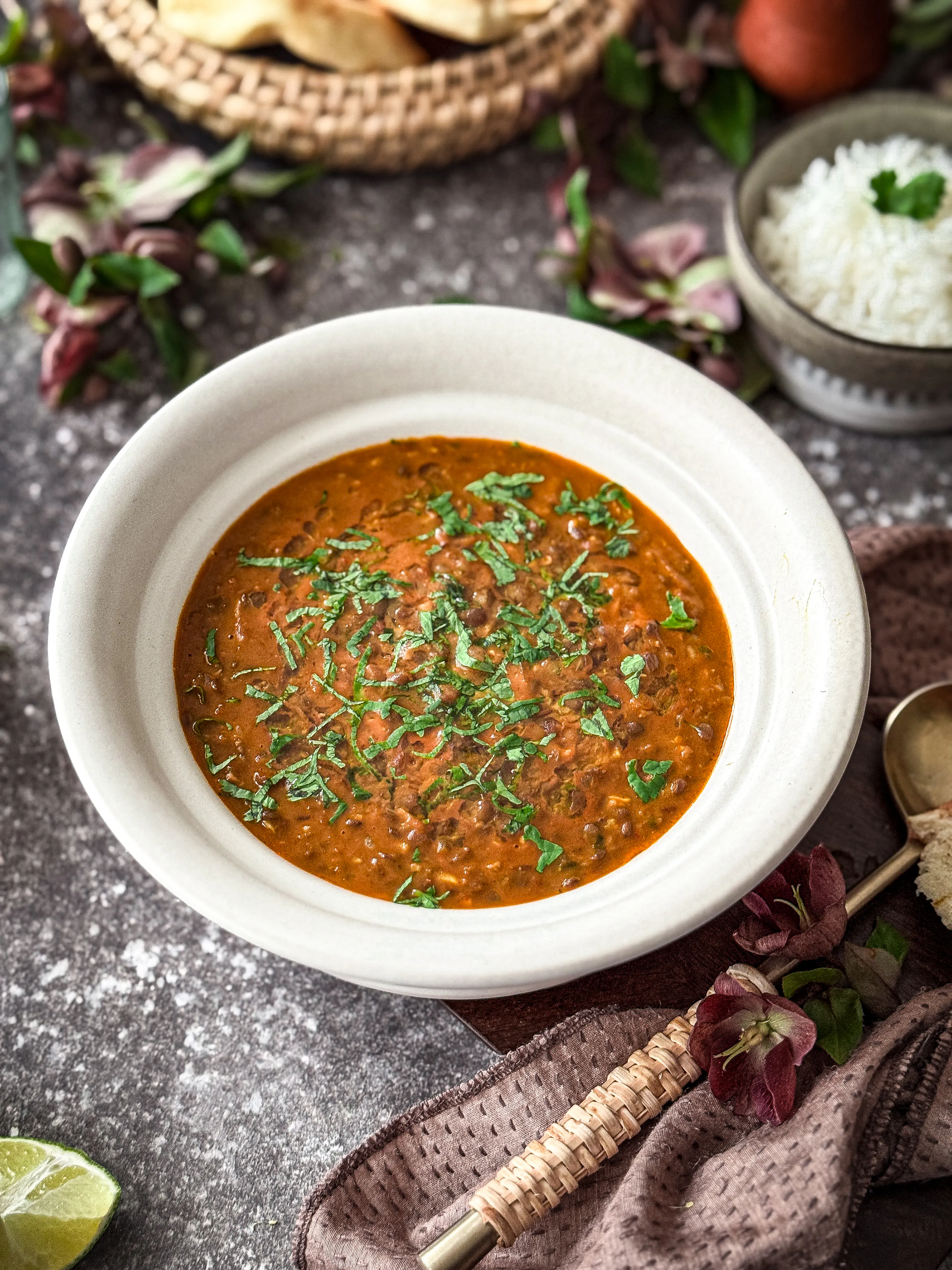
There’s something about a good dhaba-style dal that makes even the simplest meal feel special. Rich, full of flavour and finished with a generous tadka, it’s the sort of dal I can happily eat with nothing more than hot rotis, steamed rice and a bit of pickle on the side.
I’ve always loved the way dals are made at roadside dhabas in India. They’re simple, comforting and full of those familiar flavours that make you want to go back for another helping. And while dal is something we cook regularly at home, a good dhaba-style version always feels like a treat.
This dhaba-style masoor dal is made with whole brown lentils, which have an earthy flavour and hold their shape as they cook. But what really makes it stand out is the double tadka. The first builds a rich, spiced base, while the second brings that unmistakable aroma of sizzling garlic and ghee just before serving.
It’s a dal that doesn’t need an elaborate spread, although I wouldn’t say no to a bit of extra tadka on top!
Why You’ll Love this Recipe
- Made from pantry staples. Whole masoor, onions, garlic and a handful of spices are all you need, making it an easy option for a weekday meal without a special shop.
- The double tadka makes all the difference. The first tempering builds a rich, spiced base, while the second adds an extra layer of flavour with sizzling garlic and ghee.
- Filling and rich in protein. Whole masoor is a good source of plant-based protein and fibre, making this a satisfying vegetarian meal served with rice or rotis.
- Even better the next day. The flavours develop as the dal sits, so leftovers taste just as good reheated. Simply add a splash of water to loosen the consistency.
Whole Masoor vs Split Masoor Dal: What’s the Difference?
Masoor dal is one of the most commonly used lentils in Indian cooking, and you’ll find it in two forms: whole brown masoor and split red masoor. While both come from the same lentil, they differ in appearance, texture and how they behave when cooked.
Whole masoor dal (sabut masoor) is brown on the outside, with its skin still intact. It has an earthy flavour and holds its shape as it cooks, giving a thicker, heartier dal. It takes longer to cook than split masoor, but soaking it for an hour or two beforehand helps shorten the cooking time.
Split masoor dal (masoor dal) is usually orange-red because the skin has been removed and the lentil split in half. It cooks much faster and breaks down easily, giving a softer, smoother dal.
For this dhaba-style dal, I prefer whole masoor. It holds up well to the rich, spiced base and double tadka without turning mushy.

What You’ll Need
The ingredients for this dhaba-style masoor dal are quite simple. It’s the combination of spices and the two tadkas that gives the dal its distinctive flavour.
- Whole brown masoor (sabut masoor). I use whole brown lentils for this recipe as they hold their shape when cooked and give the dal a lovely, hearty consistency.
- Ginger and green chillies. Both go into the dal while it cooks and again into the first tadka. The ginger adds warmth, while the chillies bring a gentle heat. You can adjust the chillies depending on how spicy you like your dal.
- Onions. These form the base of the first tadka. Take your time cooking them until golden, as this brings out their natural sweetness and gives the dal a deeper flavour.
- Garlic. You’ll need a generous amount for this recipe, especially for the second tadka. I like to let it turn lightly golden in the hot ghee so it becomes fragrant without burning.
- Oil and ghee. I use oil for the first tadka and ghee for the second. The ghee adds richness and leaves a lingering aroma that’s such an essential part of a good Indian dal. You can replace it with oil if you’d prefer to keep the recipe vegan.
- Cumin seeds. Used in both tadkas, cumin releases its earthy aroma as soon as it hits the hot oil or ghee.
- Turmeric and Kashmiri red chilli powder. These give the dal its warm colour and gentle spice. Kashmiri chilli powder is a good choice here because it adds a beautiful red colour without making the dal overly hot.
- Kanda lahsun masala. This Maharashtrian spice blend is made with dried onions, garlic and spices. I love the savoury flavour it brings to the dal. If you don’t have it, you can use garam masala with a pinch of extra chilli powder, although the flavour won’t be quite the same.
- Black cardamom and bay leaf. These go into the second tadka, where they release their aroma into the hot ghee. Black cardamom has a smoky flavour that works well in this dal.
- Asafoetida (hing). A small pinch is enough to give the tadka its characteristic savoury aroma. If you’re cooking gluten-free, check the ingredients on the packet.
- Fresh coriander. I like to finish the dal with freshly chopped coriander for a bit of freshness against the rich tadka.
- Salt. Added while cooking the lentils and adjusted again once the dal comes together.
How to Make It
Soak and cook the lentils. Rinse the whole brown masoor thoroughly and soak it in water for 1–2 hours. Drain and transfer to a heavy-bottomed saucepan with enough fresh water to cover the lentils by about an inch. Add the ginger, green chilli and a pinch of salt. Bring to a boil, then reduce the heat, cover and simmer for approximately 30–45 minutes, or until the lentils are tender but still hold their shape. Check occasionally and add more hot water if needed. Once the lentils are tender but still hold their shape, remove and discard the whole green chilli and piece of ginger. Set the cooked dal aside while you prepare the first tadka.
Prepare the first tadka. Heat the oil in a heavy-bottomed pan and add the cumin seeds. Once they begin to sizzle, add the chopped onions and cook over a medium heat until golden. Don’t rush this stage, as properly cooked onions give the dal its rich base. Stir in the chopped garlic, ginger and green chilli, and continue cooking until the raw aroma disappears and the garlic becomes fragrant.
Add the spices. Lower the heat before adding the turmeric, Kashmiri red chilli powder and kanda lahsun masala. Stir everything together, adding a splash of hot water to prevent the spices from catching at the bottom of the pan. Let the mixture cook until the spices are well combined with the onions and the oil begins to separate slightly. This brings out their flavour without burning them.


Bring the dal together. Add the cooked masoor to the spiced onion mixture. Stir and leave to simmer over a low heat for about 5–7 minutes, allowing the lentils to absorb the flavours of the tadka. If the dal looks too thick, add some hot water until you reach your preferred consistency. It should be thick and hearty but still loose enough to spoon over rice. Taste and adjust the salt before preparing the final tadka.
Make the second tadka. Make the second tadka. Heat the ghee in a small tadka pan over a medium-low heat. Add the pounded garlic and sauté until it turns light brown and releases its aroma. Next, add the cumin seeds, black cardamom and bay leaf, and continue sautéing until the cumin begins to sizzle. Stir in the asafoetida and Kashmiri red chilli powder, followed by a splash of water to prevent the spices from burning. Cook for another minute or so, stirring until everything comes together and the ghee begins to separate.


Finish and serve. Pour the hot garlic tadka over the dal and scatter over the freshly chopped coriander. You can stir some of the tadka through while leaving the rest on top for serving. Enjoy with hot rotis, parathas or steamed rice, and some pickle on the side.
Helpful Tips and Tricks
- Don’t skip soaking the lentils. Soaking whole masoor for 1–2 hours helps it cook more evenly and reduces the cooking time. You can soak it in the morning if you’re planning to make the dal for dinner.
- Avoid burning the spices. Powdered spices can burn quickly in hot oil and turn bitter, so lower the heat before adding them. If the mixture looks too dry, a splash of hot water will help prevent the spices from catching.
- Adjust the consistency. Whole masoor continues to absorb liquid as it sits, so the dal will naturally thicken. If it becomes too thick, stir in some hot water. If it’s too thin, let it simmer uncovered for a few minutes until it reaches your preferred consistency.
- Serve the final tadka while it’s sizzling. Pour it over the dal as soon as it’s ready, while the ghee is still hot and fragrant. This helps preserve the aroma of the garlic and whole spices, which is one of the best parts of a good dhaba-style dal.
Q: Can I cook whole masoor dal in a pressure cooker?
A: Yes. After soaking the lentils for 1–2 hours, drain and add them to a pressure cooker with fresh water, ginger, green chilli and salt. Cook for 1–2 whistles, then allow the pressure to release naturally. The lentils should be tender but still hold their shape. Cooking times may vary depending on your pressure cooker.
Q: Can I use split red masoor instead of whole brown masoor?
A: You can, but the result will be quite different. Split red masoor cooks much faster and breaks down into a softer, smoother dal. Whole brown masoor gives this dish its hearty texture, so I’d stick with it.
Q: Can I make this dal vegan?
A: Yes. The dal is naturally vegan apart from the ghee in the second tadka. Replace it with a neutral oil. You’ll lose some of the buttery aroma, but the garlic and whole spices will still bring plenty of flavour.
Q: Can I make it ahead, and how do I store leftovers?
A: Yes. Cook the lentils and combine them with the first tadka in advance, then refrigerate. Reheat the dal and make the second tadka fresh, so you still get the aroma of sizzling garlic and ghee. Leftovers can be stored in an airtight container in the fridge for up to 3 days, or frozen for up to 3 months. Reheat until piping hot throughout, adding a splash of water if the dal has thickened.
Q: Where can I buy kanda lahsun masala, and can I make it at home?
A: Kanda lahsun masala is a traditional Maharashtrian spice blend made with roasted onions, garlic, dried red chillies and aromatic spices. You can find it in Indian grocery shops, particularly those stocking Maharashtrian ingredients, or buy it online. It’s also possible to make your own by roasting and grinding the ingredients, although every household has its own version. I usually use a ready-made blend for convenience.
Looking For More Indian Curries?? Here are few of Our Favourites
Creamy Paneer Makhani | Easy Indian Comfort Food
Kashmiri Aloo Dum (No Onion, No Garlic)
If you make this recipe I’d love to hear how it turned out. Leave a comment below and let me know. It genuinely makes a difference to know what’s working and what isn’t, and I read every single one. You can also find me on Pinterest, Instagram and Facebook where I share new recipes, behind the scenes and whatever else is happening in the kitchen at Poetry of Spices.

Ingredients
For Cooking the Dal
- ½ cup whole brown masoor (sabut masoor), soaked for 1–2 hours
- Water, enough to cover the lentils by 1 inch
- 1-inch piece of ginger
- 1 whole green chilli
- A pinch of salt
For the First Tadka
- 2 tbsp oil
- 1 tsp cumin seeds
- 2 medium onions, finely chopped
- 4–5 garlic cloves, chopped
- 1-inch piece of ginger, finely chopped
- 1 green chilli, chopped
- ¼ tsp turmeric powder
- 2 tsp Kashmiri red chilli powder
- 1 tbsp kanda lahsun masala
- A splash of hot water
- Salt, to taste
For the Second Tadka
- 1 tbsp ghee
- ¼ tsp cumin seeds
- 1 whole black cardamom
- 1 bay leaf
- 5–7 garlic cloves, sliced
- ¼ tsp asafoetida (hing)
- 1 tsp Kashmiri red chilli powder
- A handful of fresh coriander, chopped
method
- Soak and cook the dal. Rinse and soak the whole masoor for 1–2 hours. Drain and transfer to a heavy-bottomed saucepan. Add enough fresh water to sit about an inch above the lentils, along with the ginger, whole green chilli and salt. Bring to a boil, then cover and simmer over a low heat for approximately 30–45 minutes, until tender but still holding their shape. Add more hot water if needed. Remove and discard the ginger and chilli, then set the cooked dal aside.
(½ cup whole brown masoor, water to 1 inch above the lentils, 1-inch ginger, 1 whole green chilli, pinch of salt) - Prepare the first tadka. Heat the oil in a pan and add the cumin seeds. Once they sizzle, add the onions and sauté over a medium heat until golden. Add the chopped garlic, ginger and green chilli, and cook for another 1–2 minutes until fragrant.
(2 tbsp oil, 1 tsp cumin seeds, 2 medium onions, 4–5 garlic cloves, 1-inch ginger, 1 green chilli) - Add the spices. Reduce the heat and stir in the turmeric, Kashmiri red chilli powder and kanda lahsun masala. Add a splash of hot water to prevent the spices from burning and cook until the mixture is well combined and the oil begins to separate.
(¼ tsp turmeric powder, 2 tsp Kashmiri red chilli powder, 1 tbsp kanda lahsun masala, splash of hot water) - Combine and simmer. Add the cooked dal to the spiced onion mixture and stir well. Simmer over a low heat for 5–7 minutes, adding hot water if needed to adjust the consistency. Season with salt to taste.
(Cooked masoor dal, salt to taste, hot water as needed) - Prepare the second tadka. Heat the ghee in a small tadka pan. Add the cumin seeds, black cardamom and bay leaf. Once fragrant, add the sliced garlic and fry until lightly golden. Stir in the asafoetida, remove the pan from the heat and add the Kashmiri red chilli powder, allowing it to sizzle briefly without burning.
(1 tbsp ghee, ¼ tsp cumin seeds, 1 black cardamom, 1 bay leaf, 5–7 garlic cloves, ¼ tsp asafoetida, 1 tsp Kashmiri red chilli powder) - Finish and serve. Immediately pour the hot tadka over the dal and garnish with freshly chopped coriander. Serve hot with steamed rice, rotis or parathas.
(Fresh coriander)